
The Salish Sea ecosystem is among the most productive and ecologically diverse ecosystems in the world.
The Fraser River Estuary is vital in bringing nutrients and freshwater circulation to its shores, which in turn supports wildlife habitat and coastal communities. All of BC is broadly connected to this ecosystem through the 11 other major rivers that flow to this inland sea. The Salish Sea is the home to Southern Resident killer whales (SRKW), wild salmon, migratory shorebirds, eelgrass meadows, coastal communities, and Indigenous Nations whose relationships with these waters stretch back since time immemorial. 102 at-risk species depend on this ecosystem for survival—an ecosystem that is already facing challenges.
But today, this ecosystem faces unprecedented pressure.
With the Building Canada Act (Bill C-5), the federal government is rapidly rewriting the rules that govern how major projects are approved and regulated. This new legislation prioritizes short-term economic gains over nature, fast-tracked approval processes, and sweeping changes to environmental oversight, making it easier than ever to push dangerous industrial projects through to approval, with minimal public accountability, environmental safeguards, and meaningful Indigenous consultation.
Proposals like the West Coast Pipeline and the conversion of Roberts Bank Terminal 2 into a major oil export hub threaten to dramatically increase tanker traffic, pollution, habitat destruction, and industrial development throughout the Salish Sea.
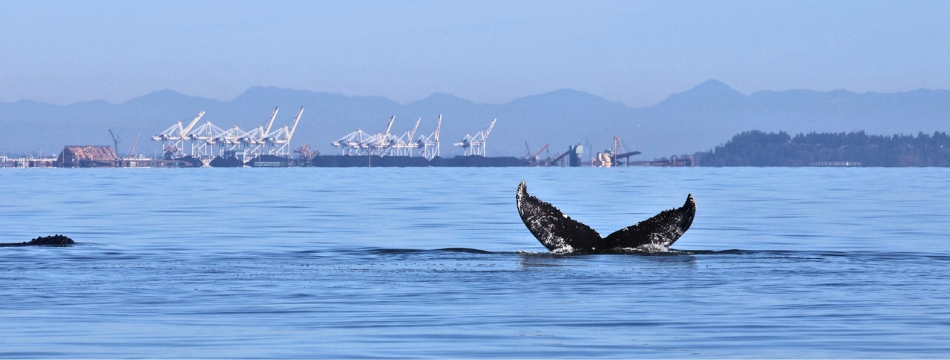
Humpback whales near Roberts Bank Terminal 2 (Photo credit: Jade Baird)
It’s difficult to emphasize how utterly devastating these projects would be to the Salish Sea.
They would destroy vital juvenile Chinook habitat, drastically increase underwater noise pollution, and exponentially increase the likelihood of a catastrophic oil spill. The projects would push the 102 at-risk species that call this unique ecosystem their home closer to extinction, including the critically endangered SRKW.
An abundance of research shows that it’s just not possible to mitigate the environmental harm of these projects on the fragile Fraser River Estuary. Salmon, killer whales, and dozens of other species will see their ecosystems irreversibly destroyed…and for coastal communities and Indigenous Nations, the Salish Sea will never look the same again.
These projects and policy changes risk transforming the Fraser Estuary and Salish Sea from living ecosystems into industrial corridors.
How did we get here?
The rapid changes the government has made to the environmental assessment process and how industrial projects are approved are not only devastating for endangered species and coastal communities, but also pose a threat to our democratic system. Yet all the political and legislative jargon can make it challenging to understand what’s changed, so let’s break it down.
In Canada, since the 1970s, for a major project to be approved, it has had to undergo an environmental assessment. Environmental assessments are a regulatory tool that measures a project’s social, economic, and environmental impacts: picture scientists trying to assess how habitat destruction from a new port could affect an endangered whale population, for example.
Yet environmental assessments have seemingly done little to protect nature. Since 1970, wild animal abundance has decreased 60% globally, largely connected to industrial development. So what went wrong?
While environmental assessments are an important regulatory tool that early environmental movements fought for in the 1970s, they are flawed. One study found that 31 out of 32 projects where endangered marine mammals were assessed were approved to be built in Canada from 2009 to 2019. In other words, they often prioritize the economy over the environment, at the expense of endangered species.
And yet, despite their flaws, they are one of the only environmental safeguards that vulnerable communities and endangered species have in the face of industrial development, and have been an incredibly important leverage point for many legal interventions (like the ones GSA uses) to protect nature, some of which have been instrumental in building a better legal and policy framework for ecosystems.
It took decades of work to create this system, however flawed, and to this day, many environmental organizations, scholars, and First Nations have continued to fight to improve it. Decades of advocacy, working towards a future where environmental assessments prioritize environmental protections over economic projections.
Yet all of this changes in 2025.
Under the threat of American economic aggression, Prime Minister Mark Carney and the Federal government looked to rapidly rewrite the rules of project approval and environmental assessment in Canada, taking us decades into the past and undoing years of advocacy work by dramatically weakening the environmental assessment process.
In June 2025, Bill C-5 was introduced. It did a few key important things. It allowed the federal Cabinet to fast-track major projects such as ports, pipelines, and energy projects by designating them as projects of “national interest”. Once designated, these projects receive automatic federal approval through a single ministerial authorization. This process bypasses many standard regulatory requirements, including environmental assessments and First Nations consultation.
In other words, Bill C-5 shredded the environmental assessment process, moving it away from transparent, evidence-based scientific review, to approving projects based on centralized political discretion.
More pipelines, ports, and energy projects with no safeguards to protect fragile wildlife or vulnerable communities.
Despite federal laws like the Species At Risk Act (SARA), which prohibits the construction of projects that could harm an endangered species, and United Nations Declaration on the Rights of Indigenous Peoples Act (UNDRIPA), which mandates free, prior, and informed consent from Indigenous peoples, projects can now be approved without proper scientific review to see if they should proceed based on how they would impact an endangered species, and, critically, without meaningful consultation from First Nations.
It’s disturbingly undemocratic. Laws, and to put it bluntly, our entire regulatory system that Canadians worked decades for, are being thrown out the window in the name of industrial expansion, making it extremely hard to legally challenge the approval of these projects.
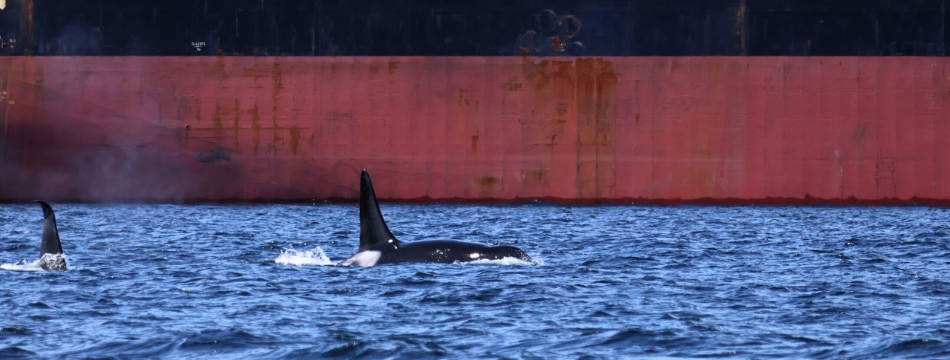
Orcas in front of a tanker. (Photo credit: Jade Baird)
Rewriting the Rules to Build Roberts Bank Terminal 2 and a New West Coast Pipeline
Now that we understand environmental assessments and Bill C-5 better, let’s bring it back to the Salish Sea.
Roberts Bank Terminal 2 is a container port expansion that was proposed by its proponent, the Vancouver Fraser Port Authority, in 2013 and approved to be built in 2023. It would cause catastrophic damage to the Fraser River Estuary and the Salish Sea. It will likely threaten the survival and recovery of the Southern Resident killer whales, pushing the population further towards extinction
How was it approved, then, when Canada has federal legislation like SARA that prohibits any activity that could harm a listed species?
Many scholars have shown that proponents will downplay how harmful a project will be to a SARA-listed species to smooth the path towards project approval. If the proponent finds that their proposed project will harm a SARA-listed species, it could doom their project, which is why they’ve developed tactics to avoid findings of harm. Vancouver Fraser Port Authority was no different, and consistently downplaying how harmful Roberts Bank Terminal 2 would be to the endangered killer whales seems to have worked in their favour.
As the construction of Roberts Bank Terminal 2 will destroy the Southern Resident killer whale’s legally defined critical habitat, it cannot be built until it receives its SARA-compliant permits from the Department of Fisheries and Oceans (DFO). Legally, these permits can only be granted if DFO is confident the project will not harm the survival and recovery of the Southern Resident killer whales.
During the environmental assessment process, DFO publicly stated they were uncertain the department could grant the project these permits due to the project’s destruction of the whales’ critical habitat.
The permitting process is like a black box—the public will never know how the decision was arrived at, which in itself is undemocratic. The permitting decision was scheduled to be announced by October 2026. For many legal experts, it felt very possible that the project would not receive these permits. How could it, when it was so abundantly obvious that Terminal 2 would harm the killer whales?
But in July 2026, the Major Projects Office designated Roberts Bank Terminal 2 as a ‘project of national interest.’ This exempts the project from needing its permits.
What does this mean? It’s likely the federal government knew it wasn’t possible for Roberts Bank Terminal 2 to receive its SARA-compliant permits because of how the project will harm the Southern Resident killer whales. This would explain why, in May 2026, the government proposed weakening the jeopardy clause for projects of national interest to make it easier for Terminal 2 to be built. The jeopardy clause in SARA is a critical safeguard that prevents projects from moving forward if they are harmful to a species’ survival or recovery.
It’s a last ditch effort to ensure this unlawful project, which defies both SARA and UNDRIPA, is built.
Today, we know Roberts Bank Terminal 2 is expected to be more than just a container port. It’s been announced that the new West Coast Pipeline will be constructed from Alberta to Terminal 2, with an extra $10 billion being funneled towards RBT2 to upgrade it to a crude oil terminal. It’s even less likely that a pipeline could be approved given the protections SARA affords the Southern Resident killer whales, which is why the government has spent the last year systematically eroding environmental protections on the Fraser River Estuary.
The federal government had to ensure all the legal avenues to reject this pipeline were eliminated, even if it results in the extinction of an entire species.
What jobs? The questionable economics of these destructive projects
How does the government justify these unlawful projects? It’s a narrative we’ve been told for decades—more jobs, a boost to the economy. That these projects are in the ‘national interest’ despite the ecological devastation they’ll cause.
But whose national interest are these projects in?
Proponents and the federal government have a history of exaggerating job projections. Kinder Morgan overinflated employment projections in BC for TMX’s construction period by 200%. An independent report found the pipeline would generate 800 full-time jobs in total for the operational period, less than 0.1% of BC employment.
Other similar large-scale projects have been found to only realize 12 jobs for every 100 promised.
For over a decade now, many scientists, politicians, Indigenous Nations, and concerned citizens have questioned the rationale for Roberts Bank Terminal 2. The new terminal will be semi-automated, which means, to an undetermined degree, machines will replace human jobs. The union that represents the longshore workers at Roberts Bank says the new terminal will result in a net loss of jobs, estimating 4,000 jobs could be lost across BC if the new terminal is built.
Worse, container traffic has not increased enough to justify the need for Roberts Bank Terminal 2 to be built. In 2012, the Vancouver Fraser Port Authority estimated that container traffic will have doubled at Roberts Bank Terminal 2 by 2027.
At its best, container traffic has only increased by 37%.
Why do we need these destructive projects if the potential jobs and economic growth are shaky and uncertain and the devastation they’ll cause to the Fraser River Estuary and Salish Sea is guaranteed? We know that the health of the Fraser Estuary is more valuable in the long run.

The graph from the 2013 Terminal 2 project description that shows the forecasted high, base, and low case throughput of TEUs (the unit of measurement for containers) moving through VFPA terminals (Port Metro Vancouver 2013). The dark blue line is the actual number of TEUs that have moved through VFPA terminals from 2013 – 2023, based on VFPA financial reports (Baird, 2025).
So… Are these projects truly in the ‘national interest?’
Let’s take a step back and ask ourselves: who benefits from these projects, and who loses?
The list of who loses is long. Endangered species like the Southern Resident killer whales, Chinook salmon, and western sandpipers. The entire Salish Sea ecosystem. Communities who depend on the Fraser River Estuary, like First Nations who have traditional hunting and fishing rights rooted in this ecosystem. Dockworkers could lose their jobs, advocacy workers will lose decades of progress that gave us laws like SARA and UNDRIPA. As fossil fuel use increases, so will wildfires, leading to impacts that reverberate across all of Canada.
So then… who benefits?
It isn’t Canadians. One study found that for TMX, 68% of that pipeline’s revenue would be retained by tar sands producers, while BC would see less than 2% of the financial benefits. Many tar sands producers in Canada are foreign-owned. This pipeline will make an elite few rich, with Canadians left to pick up the pieces. This is in addition to the projection that we will have to pay up to 90% of the cost of this pipeline from our own tax dollars. TMX, another pipeline that was bought with taxpayer money, has not been profitable, despite the clever accounting they use.
How can we claim, then, that these projects are in the national interest?
We believe that preserving one of the most productive and ecologically diverse ecosystems in the world is in our national interest. A future that holds a healthy Southern Resident killer whale population and rivers filled with thriving salmon. A future where Roberts Bank is covered in western sandpipers, not tankers.
Species extinction is not in our national interest.
Written by Jade Baird, GSA Community Organizing Assistant
Canada is a Democracy. We follow laws and we respect their importance. If the Prime Minister proposes to disregard iconic Environmental Legislation to further a Political Agenda then this can not be permitted. He is an elected leader not a King. It is plain. It is simple. Calling an Industrial enterprise a project of National Interest in Peacetime is ridiculous.
Canadians must not give up their protections so very easily. It is too dangerous.
When will this stop that the big corporations run governments. Mr Carney ought to be ashamed at his shortsightedness concerning our Pacific coast the Salish sea, the profound ecosystem that has been created over centuries all to be threatened again by Oil. More destruction and more money for white humans. We do not live alone we are intradependant with the land and all life. Wake up.
The pipeline does not fit into the change we need live sustainably on this planet.
Wake up to the climate change….you are moving too fast. think of your children think of those grandchildren.
Wake your heart up.