Risks will push Southern Resident killer whales further towards extinction while expanding fossil fuel extraction in a time of climate crisis.
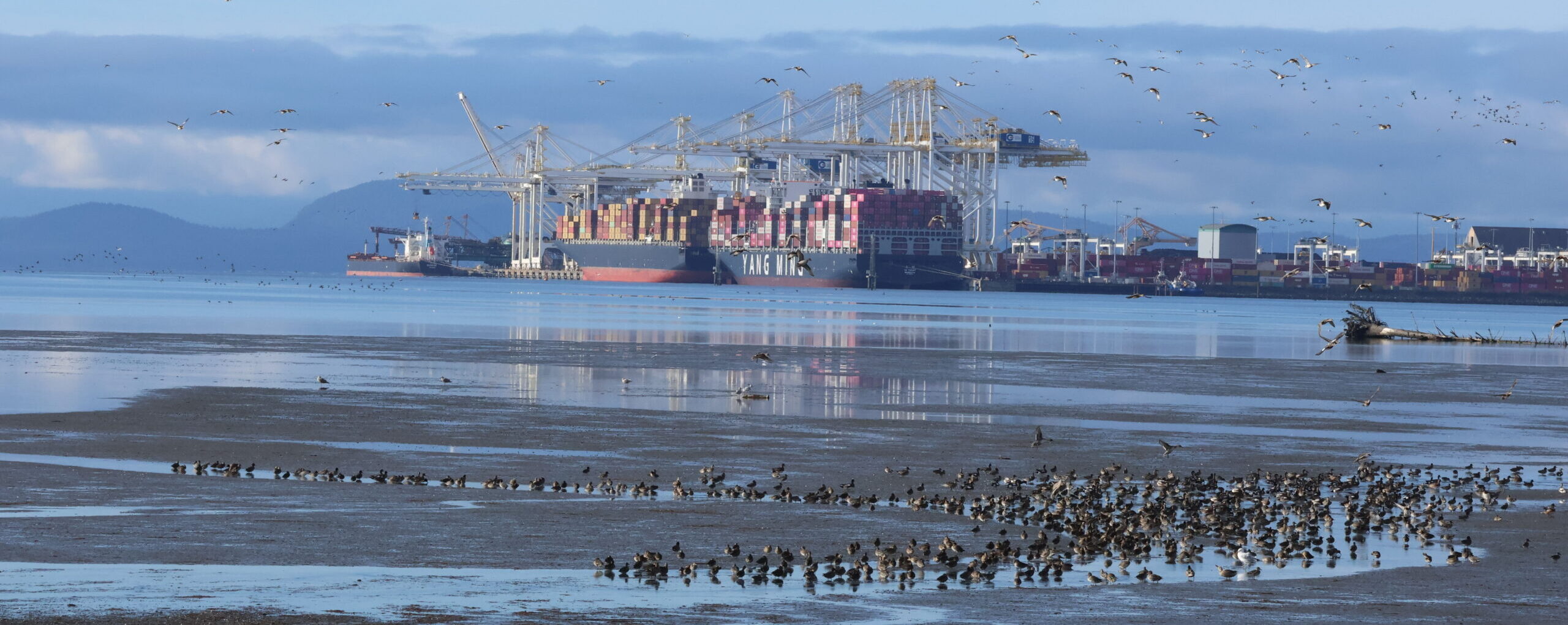
The Federal Government has announced today that Roberts Bank Terminal 2 (RBT2) is now a ‘Project of National Interest’ (PONI). This reinforces the federal government’s commitment to building pipelines, ports, and major projects at any cost, including pushing beloved species like the Southern Resident killer whales (SRKW) firmly towards extinction.
Since RBT2 was proposed in 2013, environmentalists, Indigenous Nations, community groups, political figures, and people that depend on the Salish Sea for their livelihoods have vehemently opposed this port expansion. The proposed port expansion threatens critical Chinook salmon habitat in the Fraser River estuary, Western Sandpipers, and the survival of the critically endangered SRKW, among other threats.
The Salish Sea deserves better than a future defined by ecological destruction and the loss of the species that call it home.
Shortcut around environmental protections
RBT2 has long been deeply contentious, with serious concerns about the adequacy of its environmental assessment, and the reliance on mitigation measures has yet to be proven effective.
Granting this designation at the eleventh hour before the Species at Risk-compliant permitting decision was set to be made circumvents critical environmental protections that people have fought decades for. It usurps decades of progress to protect killer whales and Chinook salmon, shifting decision making from scientific evidence-based processes to political discretion, and continues the systematic dismantling of our regulatory and consulting framework for how major projects are managed.
Despite federal assurances, there is no credibility that RBT2 can be built without harming SRKW and other species: cabinet conceded at the time that those conditions were not enough to prevent significant adverse effects to salmon and the SRKW. Ultimately, this project was approved based on a highly flawed environmental assessment and unproven mitigation measures that Vancouver Fraser Port Authority can simply opt out of if they are deemed ‘too expensive’, courtesy of Bill C-39, which is slated to become law by the end of 2026. Additionally, with the introduction of the new Bill, the 370 legally binding conditions this destructive project had to adhere to—which are already insufficient—could be further weakened or removed entirely.
Quotes:
“Approving RBT2 as a Project of National Interest puts an already stressed Salish Sea at greater risk. As fossil fuel infrastructure expands at enormous cost to taxpayers and Bills C-5 and C-39 threaten environmental protections, endangered Southern Resident killer whales, Chinook salmon, and the health of the entire Salish Sea are put further at risk. This decision undermines decades of work by Indigenous Nations, scientists, and communities to protect this irreplaceable ecosystem.” – Beatrice Frank, Executive Director
“A question we must ask is why RBT2 is being designated as a Project of National Interest when the Species at Risk-compliant permitting process is almost complete? This designation gives a free pass to circumvent the environmental safeguards needed to protect the future of the critically endangered Southern Resident killer whales and other species at risk that call this region home. How many species must we push towards extinction before agreeing it is not in the ‘national interest’?” – Maithili Devadas, Biodiversity Campaigner
“Asked what the PONI designation changes for an already-approved RBT2, Transport Minister Steven MacKinnon pointed to outstanding permits and said it was “time to move on.” The message is clear: the project is moving ahead, regardless of the consequences for endangered species and ecosystems. How can Canadians trust a government to protect nature when it legislates to override its own environmental laws and safeguards?” – russ elliott, Campaigns Manager
Not in our National Interest
Georgia Strait Alliance calls on the federal government to uphold existing environmental protections, respect Indigenous rights, and put the long-term health of the Salish Sea ahead of short-term political and economic interests. Pushing species already at grave risk further towards extinction cannot be in the ‘national interest’. The long-term health and resilience of the Salish Sea must be central while making decisions that drastically alter the future of the region.
Media contacts:
Beatrice Frank, Executive Director – beatrice@georgiastrait.org
VANCOUVER/UNCEDED xʷməθkʷəy̓əm (MUSQUEAM), Sḵwx̱wú7mesh (SQUAMISH), AND səlilwətaɬ (TSLEIL-WAUTUTH) TERRITORIES
Image: Jade Baird